


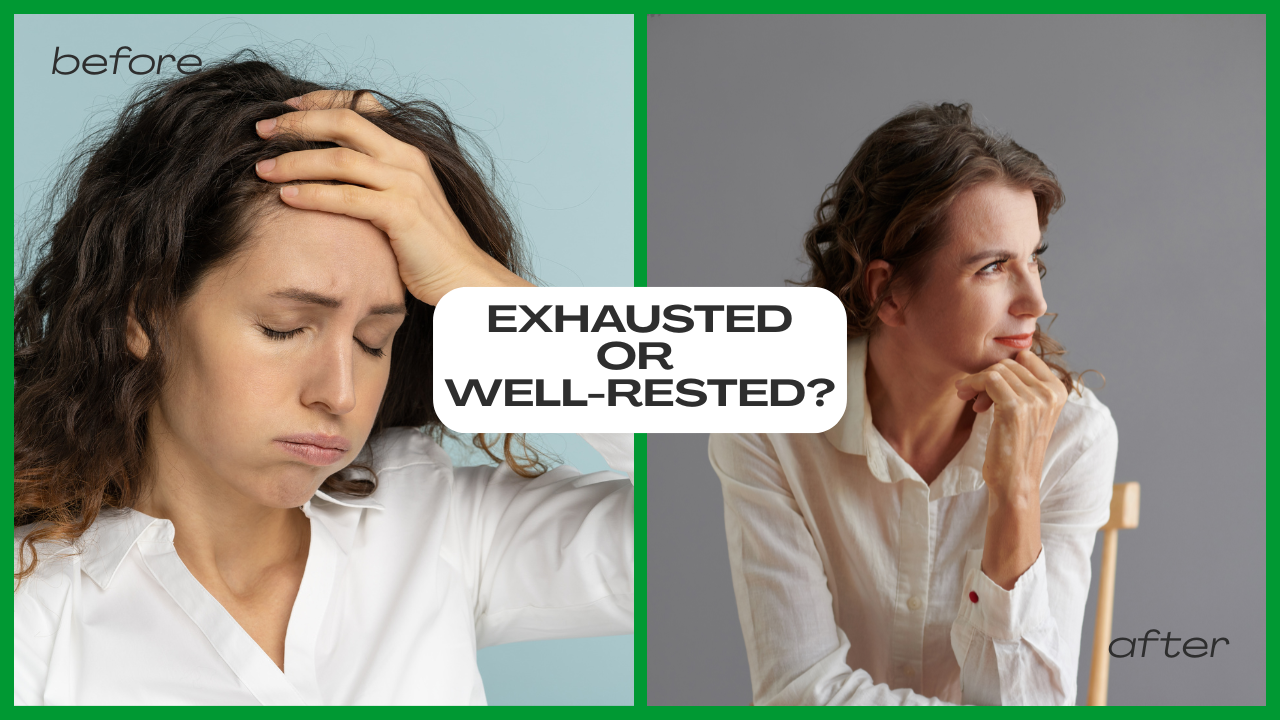
We often wear exhaustion like a badge of honor. We brag about how little we slept, how much coffee we consumed, and how late we stayed up to finish a project. But have you stopped to ask yourself: How are you really doing? Are you getting enough rest to fuel your day, or are you running on empty? Are you just surviving instead of thriving? What would it feel like to be well-rested?
Pause for a moment—do any of these sound familiar?
- Do you hit snooze more than once each morning?
- Do you rely on caffeine to keep your eyes open by mid-afternoon?
- Is your mind foggy, making decision-making harder than it should be?
- Do you feel irritable, anxious, or less resilient under stress?
- Are you nodding off during meetings or while watching TV?
- Does your body ache or do you wake up feeling stiff and unrested?
If you recognize these symptoms, your body may be begging for more quality sleep.
It’s time to rewrite that narrative and to establish a new normal where waking up vibrant, pain-free, and energized isn’t a luxury—it is your standard.
Prioritizing the importance of sleep is the single most effective step you can take toward a healthier, happier life. But how much sleep is truly enough for you? Here’s a simple self-assessment:
Your Personalized Sleep Sufficiency Guide
- Try, when possible (like on holiday or a free weekend), going to bed when you’re tired and waking up without an alarm. How many hours do you naturally sleep?
- Do you wake feeling refreshed, energetic, and ready to take on the day—or do you still feel groggy and need to nap, even after a long sleep?
- Notice your mood, memory, and physical energy throughout the day. Are you consistently hitting a wall by mid-afternoon, or do you sail through with clarity?
- Track these patterns for several nights. Most adults need 7-9 hours per night, but optimal sleep is highly individual.
When you allow yourself to “sleep until you’re done”—free from alarms and obligations—you give your body permission to reset and reveal its true sleep needs. Use this experiment as your baseline, then strive to honor that need, even outside of vacation mode.
This article explores how deep, restorative rest functions as the foundation of your well-being. We will uncover the biological magic that happens when you close your eyes, the critical role your sleep environment plays, and the healthy sleep habits you can adopt today to transform your nights.
Why We Must Redefine Our Relationship with Rest
Do you wake up feeling truly refreshed, or are you dragging yourself out of bed, already dreading the day? If the latter sounds familiar, you aren’t alone. Statistics show that nearly one-third of adults report sleeping less than seven hours a night. This chronic rest deficit impacts everything from our immune system to our emotional resilience.
It’s time to shift our perspective. Sleep is not merely “downtime” or a pause in productivity. It is an active, metabolic state where your body performs its most critical work. Viewing sleep as a pillar of health—just like nutrition and exercise—empowers you to make choices that support your longevity.
The Hidden Biology of a Good Night’s Sleep
What actually happens when you drift off? It isn’t just darkness and dreams. Your body engages in a complex symphony of repair and regeneration. During sleep, these are just a few of the critical functions your body performs while you snooze:
- Your brain clears out metabolic waste products, including beta-amyloid, a protein associated with Alzheimer’s disease.
- Your pituitary gland releases growth hormones essential for muscle repair and tissue growth.
- Your immune system produces cytokines, proteins that help fight infection and inflammation.
Without restful nights, these processes are interrupted. Cortisol levels spike, leading to stress and weight gain. Cognitive functions like memory consolidation and problem-solving plummet. By understanding the technical necessity of sleep, we stop viewing it as optional and start seeing it as vital fuel for our biology.
Orchestrating Restful Nights: Start With Your Environment
You can have the best intentions, but if your bedroom fights against your biology, deep sleep will remain elusive. The quality of your sleep system is paramount. Is your mattress merely a soft surface, or is it a tool for health?
Your Bed and Orthopedic Support
To achieve truly restorative sleep, your body needs to be free from tension. A standard mattress often creates pressure points, cutting off circulation and forcing you to toss and turn.
The SAMINA sleep system takes a different approach. By utilizing a highly flexible slat frame that mimics the human spine, we ensure that your body is supported orthopedically. Imagine lying down and feeling your spine align perfectly, your lower back supported with just enough support, while the rest of your body is gently cradled, and your shoulders sink in just enough to release the day’s tension. This isn’t just comfort; it is anatomical necessity. When the body is physically aligned, the nervous system can switch from “fight or flight” to “rest and digest,” facilitating deeper sleep cycles.
Grounding and Non-Toxic Materials
Have you considered what you are breathing in while you sleep? Many conventional mattresses are laden with petrochemicals and fire retardants that off-gas harmful VOCs.
Your “new normal” should involve sleeping in a pristine environment. We use natural, breathable materials like organic sheep’s wool, which regulates temperature and wicks away moisture. Furthermore, integrating grounding pads into your sleep system can bring your body back into balance with an anti-oxidant effect and even help neutralize the impact of electromagnetic fields (EMFs) that surround us everywhere now and can interfere with your natural sleep rhythm. This technical attention to detail ensures that your sleep sanctuary is not just comfortable, but biologically compatible with your needs.
Cultivating Healthy Sleep Habits for Life
Creating a sleep-conducive environment is step one. Step two is behavior. Adopting healthy sleep habits signals to your body that it is time to wind down.
- Respect the Circadian Rhythm: Your body runs on an internal clock. Try to go to bed and wake up at the same time every day, even on weekends. This consistency regulates your melatonin production.
- The Power of Darkness: Light is the enemy of sleep. Ensure your room is pitch black. Even a small amount of light from a streetlamp or an alarm clock can interfere with deep sleep phases.
- Digital Detox: The blue light emitted by phones and tablets mimics sunlight, tricking your brain into thinking it is daytime. Commit to putting screens away at least an hour before bed.
- Temperature Control: Your body temperature needs to drop to initiate sleep. Keep your bedroom cool, ideally between 60-67 degrees Fahrenheit. The breathable layers of a SAMINA system work in tandem with this, preventing the overheating that wakes so many people up in the middle of the night.
Embrace Your New Normal
You deserve to feel incredible. You deserve to greet the morning with clarity and enthusiasm. This isn’t a pipe dream; it is a biological reality waiting for you to claim it.
By acknowledging the importance of sleep, investing in a sleep system that supports your anatomy, and practicing healthy sleep habits, you are doing more than just resting. You are investing in your future self.
Make tonight the beginning of your new normal. Prioritize your rest, and watch as your health, mood, and vitality transform.
